Many patients hear the word “dentures” and automatically think of their grandparent’s dentures floating in a glass on their bedside table. However, dentures have changed dramatically over the years, and they have been greatly improved with advanced technologies. Full dentures aren’t the only type of denture a patient may have. Partial dentures also play an important role in restoring smiles after tooth loss.
Full and partial dentures are very different. Although they both replace teeth in a patient’s smile, this is where the similarities end. Full dentures are used to restore an entire arch of teeth. These dentures include acrylic gums and teeth, and they may be stabilized with dental implants. They can be used to replace the upper, lower, or both arches, depending on the patient’s needs. Partial dentures are attached to a metal frame that connects to your natural teeth in the dental arch for stability and strength. These are used when patients are missing one or several teeth within a dental arch.
Dentures are considered a temporary restoration for many, as they are not permanent and require extra care and attention. Dentures are removed for cleaning and must always be kept moist when not in use. Patients must brush and care for these teeth as they would their natural teeth and many do not like the daily reminder of tooth loss. However, they are great for patients considering long-term solutions such as dental bridges or dental implants, or for those who are on a tight budget.
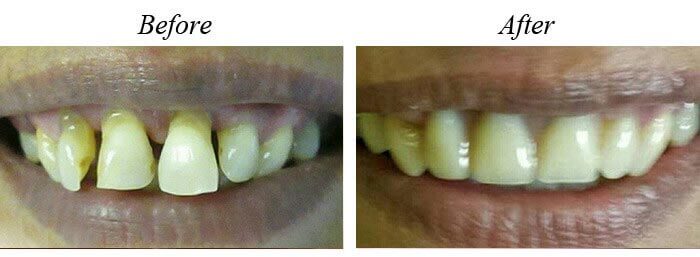
Dentures treatment to replace loose and eroded teeth from gum disease. Simple and less expensive solution to get the smile you always wanted!
Dr. Kotecha and the team at Dentistry On 10 are proud to offer full and partial dentures for the restoration of smiles. Adults of all ages can benefit from dentures, and many find that they are an acceptable way of improving their smiles without the upfront expense of alternative treatments. Patients considering dentures or other restorative solutions should contact Dr. Kotecha and her associates of Denstistry on 10 and schedule an initial consultation appointment to have any questions or concerns addressed before undergoing the process of receiving full or partial dentures.
So, tell us a little bit about you know what problem you were having before you came to dentistry on 10. Okay, my problem was that that I had my dentures for 30 years and then when I came to dentistry on 10, I met Doctor Rena you know for the first time she talked to me you know and I voiced all my problem and I was so glad you know that he listened to me for the first time, that this doctor, you know is so very national emotionally I. I was so impressed of what the caring he did to me and that the her hand is so gentle and that’s why I’ll never forget her, you know, and I as a woman like I mean we have the similarity like and that’s what I just said like about this you know when the first came in here and what she did for my teeth of course, you know. And you know, before you when you had your dentures and you know before she changed it, how was that affecting you in your life? Of course, you know it affects my, and I don’t have any confidence on myself and I don’t even smile you know, then want to open my mouth I’m always like for a long time. For 30 years I’ve always put my hands on my mouth and I don’t my mouth and I don’t want to smile at all. You know, that’s my problem. And now? And now I will never stop, you know, smiling, you know and always thinking of her and how I felt good about myself now. I felt good about myself and I thank you know doctor Rena and although you’re stopping here at dentistry on 10, they are so nice so nice. Okay, and would you recommend us to others? Course I do. I tell friends you know that the experience I have, you know, and I know some friends of mine now of course, they believe in me because of this experience I had with them to doctor Rena. Okay, thank you so much. You are welcome. I I always have this, you know, as to rated this dental office, it’s one to 10. It’s a 10. It’s always a thumbs up for me. To everyone, of course you know, I will recommend this to everyone you know. Thank you
“ Before I came to Dr. Rina I didn't have any confidence in myself and I didn't want to smile or open my mouth... Now I can't stop smiling ”
Dr. Rina Kotecha is a graduate of the Harvard School of Dental Medicine. She possesses 19 years of expertise in the dentistry field specializing in general dentistry. She has further qualifications from the MGE Executive Training Program and Master Implant Training Program while holding certification in Soft Tissue Management Program by DenMat. She completed the Rondeau Seminars in Level I Orthodontics and she is an active member of the Ontario Dental Association and Ontario Dental Implant Network.
Routine scaling or teeth cleaning is the treatment for gingivitis.
It removes the bacteria and plaque that causes bleeding of the gums, bad breath and sensitivity.